
Midcoast Maine Low-Slope Roofing Services
Residential Flat & Low-Slope Roofing in Lincoln County Since 1979
Low-slope roofs don’t shed water the way a standard pitched roof does. They have to manage it, hold up against it, and stay watertight through Maine’s full range of conditions: coastal humidity, freeze-thaw cycles, heavy snow loads, and the kind of sustained winter weather that separates a well-matched system from one that’s just hoping for the best. Getting the material selection right from the start helps prevent the chronic leaks and premature failure that come from treating a flat section like a standard roof.
Ted Weber Jr Roofing has handled residential roofing in Midcoast Maine since 1979. Ted stays personally involved from the initial estimate through project completion, which means you’re working directly with the person evaluating your roof, not a project manager passing along someone else’s notes. We assess how a roof section is structured, how it drains, and what system is actually matched to its pitch before making any recommendation.
Call us at (207) 259-4793 or reach out by using our online contact form.
When a Roofing Pitch Is Too Low for Shingles
One of the most common issues we see is shingles being used where they shouldn’t be. Standard asphalt and architectural shingles are engineered for roofs with enough pitch to move water off the surface quickly. Once you drop to around a 3:12 pitch or below, that drainage assumption breaks down. Water slows significantly and has more opportunity to work under shingle laps, and even a well-installed shingle roof can fail over time when the geometry is working against the material.
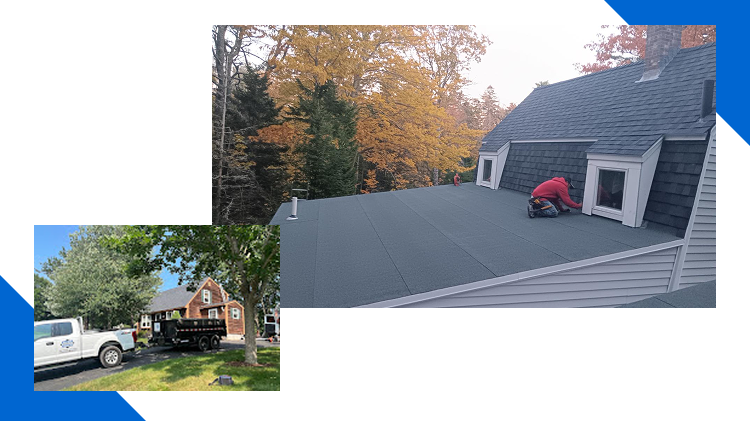
Membrane systems address this directly. A single-ply membrane like EPDM rubber creates a continuous watertight surface that doesn’t rely on overlapping laps to stay sealed. It’s the correct material match for low-slope geometry, and using shingles where a membrane is required typically leads to avoidable repair costs and a shortened roof life. We base every material recommendation on the actual pitch and drainage characteristics of your roof, not a one-size-fits-all default.
Low-Slope Roofs & Maine Winters
Maine’s winters introduce a failure mode that flat and near-flat roofs face more acutely than steep-pitch systems: ice dam formation. Low-pitch surfaces don’t shed snow, so it accumulates and sits. As it melts and refreezes along the eaves, ice dams form and force water back under whatever is covering the roof deck.
Ice and water shield underlayment can help on low-pitch shingle applications, but it has real limitations when snow and ice sit on the surface for weeks at a time. A membrane system rated for low-slope use is designed to handle ponding water without the seam-infiltration vulnerability that shingle systems carry under sustained winter conditions.
EPDM is a single-ply membrane widely used on residential low-slope applications across Maine because it flexes with the freeze-thaw cycle rather than fighting it. It expands and contracts with temperature swings without cracking or losing its seal. For homes throughout Lincoln County, that thermal flexibility is directly relevant to how the roof performs from November through April.
Built on Word of Mouth
-
"Great Job"
He and his crew did a great job, and the cleanup was excellent. Other than the new roofing, it was hard to tell they were even there.
- Jamie S. -
"Incredibly Easy Process"
His crew was amazing, very thorough and efficient, and I couldn’t believe how quickly they completed my roofing job.
- Brian M. -
"Reasonable Price"
The staff was meticulous with the roofing and the cleanup!
- Nancy S. -
"Very Good Experience"
We would definitely recommend this company.
- Debra D.